Short summary
A gravel bike is a road bike with wider tyres (35 to 50 mm) and a slightly more stable geometry, suitable for both tarmac and unpaved paths. It combines the speed of a road bike with the comfort and versatility of a mountain bike. A new gravel bike costs between € 1,000 and € 5,000.
What exactly is a gravel bike?
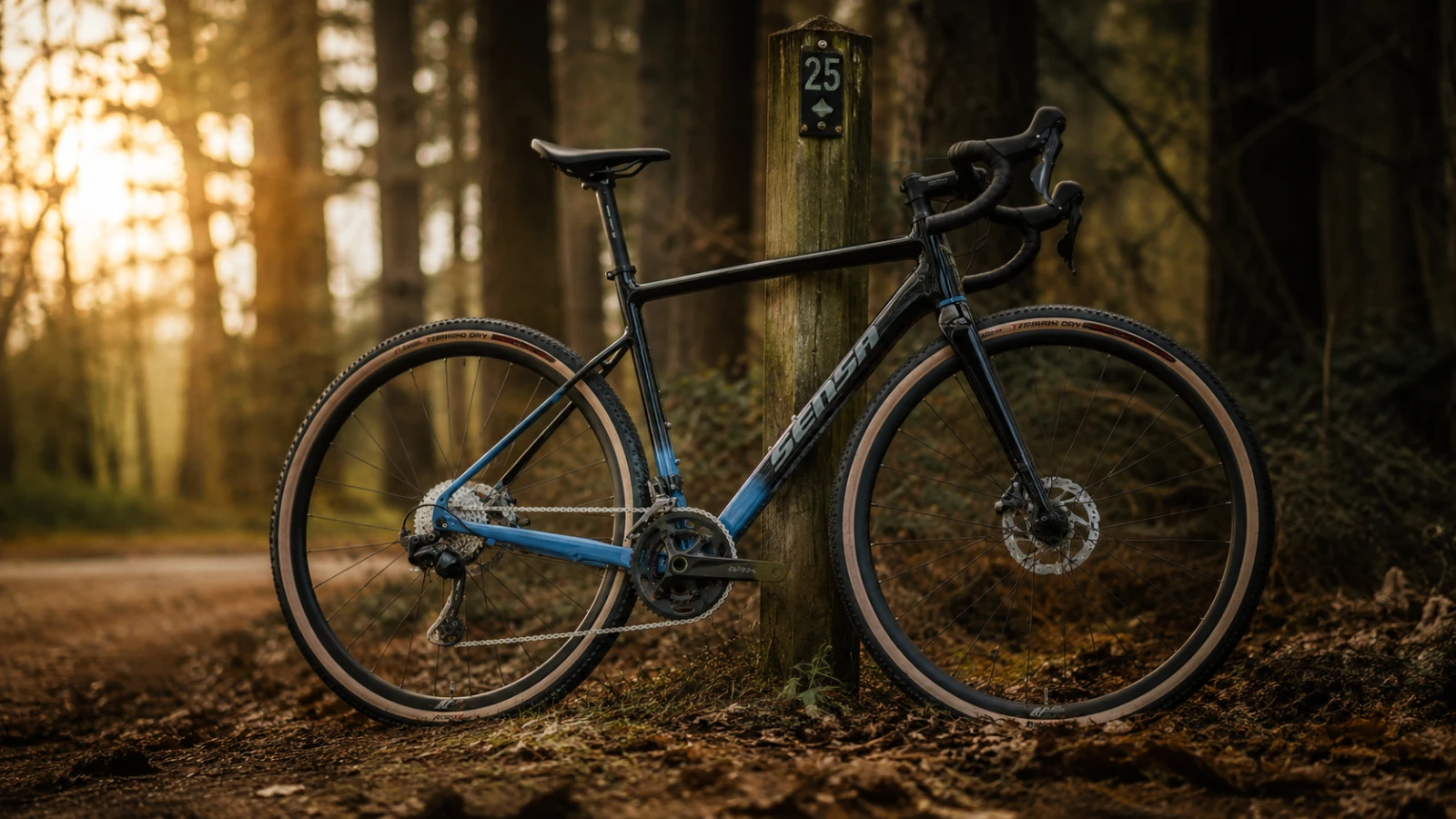
A gravel bike is a bike that sits somewhere between a road bike and a mountain bike. With drop handlebars, a lightweight frame and narrow silhouette it looks like a road bike from the outside, but it has wider tyres (averaging 38 to 47 millimetres, sometimes up to 50 mm), a slightly more robust build and geometry focused more on stability than pure speed.
The name comes from "gravel": an unpaved path with grit or fine gravel. In America this is a widespread road type. Dutch equivalents are forest paths, church paths, sunken lanes and unpaved country roads. The gravel bike is designed to handle all these surfaces without sacrificing tarmac speed.
In practice: a gravel bike lets you do a day ride that goes from cycle path to forest, back to tarmac, then over an unpaved polder road, then up a hill, and finishing with a long tarmac section back home. A road bike can't handle the second and third parts, a mountain bike is too heavy for the tarmac sections. The gravel bike does both.
What's the difference from a road bike?
Tyre width
A road bike has tyres of 23 to 28 millimetres. A gravel bike has tyres of 35 to 50 millimetres. This is the most obvious difference. Wider tyres give more comfort, more grip on loose surfaces, and more rolling resistance on flat tarmac. But the latter is much less than many people think.
Tyre tread
Road bike tyres are smooth or almost smooth. Gravel tyres have a light to pronounced tread pattern, depending on the intended use. For hard gravel paths a light tread is sufficient; for softer or muddy surfaces you want more knobs.
Geometry
A road bike is built for speed on flat tarmac: low front end, short chainstays, aggressive riding position. A gravel bike has a slightly more upright riding position, a longer wheelbase (for stability on loose terrain), and a bit more clearance for wide tyres. The difference is subtle but noticeable.
Gearing
On a road bike you often find an 11-speed groupset with gear ratios optimised for 30+ km/h on flat tarmac. A gravel bike often has a wider range, with a lighter smallest gear to tackle steep unpaved climbs.
What's the difference from a mountain bike?
The handlebars
A mountain bike has flat bars. A gravel bike has the curved road bike handlebars (drop bars). This has consequences for the types of hand positions you can adopt and thereby for aerodynamics and comfort on longer rides.
The tyre width
Mountain bike tyres are wider than gravel tyres (often 2.1 inch and wider, with substantial knob pattern). With these they go through technical terrain a gravel bike cannot handle: mud, roots, technical descents, steep rocky paths.
Suspension
Mountain bikes have suspension, either front only or front and rear. A gravel bike (almost) always has no suspension. This saves weight and keeps the bike fast on tarmac, but makes it unsuitable for really technical terrain.
Practical difference: a gravel bike is a bike for those who spend 70% of their time on tarmac or hard paths and 30% on genuinely unpaved surfaces. A mountain bike is for those who want to ride 70% technical off-road and 30% via tarmac to the next trail.
Who is gravel biking suitable for?
A gravel bike is essentially the most versatile bike on the market. Four groups benefit specifically from it:
Road cyclists who want to escape the busy cycle paths
Many experienced road cyclists have grown tired of sharing narrow cycle paths with mopeds and e-bikes. A gravel bike opens up hundreds of kilometres of quiet forest paths, church tracks and country roads that are unreachable on a road bike.
Mountain bikers who also want to ride normally sometimes
An MTB on tarmac is slow and heavy. For those who, alongside technical MTB riding, also want to do long rides over mixed terrain, a gravel bike is a pleasant second bike.
Commuters with a long or mixed route
Those who cycle to work over a combination of cycle path, forest path and unpaved sections have an ideal partner in a gravel bike.
Recreational cyclists who want more than a village loop
For those who want to do weekend rides of 50 to 100 kilometres through varied landscape, the gravel bike is more suitable than both a hybrid and a road bike.
Not suitable for: urban commuters who only cycle through the city (overkill), pure racing cyclists (a proper road bike is faster), and people who only want to do technical MTB riding (MTB is clearly the right choice there).
What do you need to get started?
Do you necessarily need a new bike?
No. A second-hand gravel bike or an adapted road bike with wider tyres can also work. But if you want to enjoy it for a longer period and ride on various types of paths, a proper gravel bike helps. Especially because of the geometry and the tyre clearance in the frame.
Do I need special clothing?
Strictly speaking, no. But cycling shorts with a chamois (corduroy is not recommended after 50 kilometres), a cycling jersey that wicks sweat, and gloves for vibration damping help considerably. For longer rides also cycling shoes with a clipless system.
Do I need clipless pedals?
No, but recommended for rides longer than 30 kilometres. SPD (mountain bike system) is more suitable than SPD-SL (road bike system), because you occasionally have to walk on muddy paths and SPD clips out more easily.
Helmet?
No legal requirement in the Netherlands, but for those riding gravel paths with loose stones and descents a helmet is strongly recommended. At Courtens we have it as an add-on with every rental bike.
What tyre width do I need?
This depends on the terrain:
- Forest paths and hard gravel paths (Dutch forest, Belgian towpaths) → 35–40 mm
- Limburg hills with stony surface → 42–47 mm
- Soft surface, sandy paths, clay roads → 45–50 mm
- Commuter route with gravel and tarmac sections → 38–42 mm
For South Limburg specifically: minimum 40 mm, ideally 42 to 47 mm. Limburg paths have a lot of sharp stones. Narrower tyres lead to more punctures. That's why our rental bikes have 47 mm Vittoria tyres.
Tubeless or clincher: tubeless gives fewer punctures and you can ride at lower pressure (more comfort). Clincher is easier to repair on the road. For those just starting out with little maintenance experience, clincher is fine.
What does a gravel bike cost?
Entry level (€ 800 – € 1,500)
Aluminium frame, basic groupset (such as Shimano Tiagra or GRX 400/600), mechanical disc brakes or even cantilevers. Good to start with, but the groupset will reach its limits on steep climbs or longer rides. Suitable for those who want to see if gravel biking works for them, but without a large investment.
Mid-range (€ 1,500 – € 3,000)
Aluminium frame with carbon fork, or an entry-level carbon frame. Full Shimano GRX groupset (RX600 or RX800 with 11 or 12 speeds). Hydraulic disc brakes. Wide tyres up to 47–50 mm. For most people who want to get serious about gravel biking this is the sweet spot. The Sensa Romagna XP GRX 2x12 we rent falls in this class (€ 1,899 new).
Premium (€ 3,000 – € 7,000+)
Full carbon frame, top components (Shimano GRX 12-speed electronic, SRAM Force/Red XPLR, or equivalent). Lighter wheels, premium tyres. For competition-oriented users or people for whom money is no object and who like cosmetically fine hardware.
Important note: the difference between class 2 and class 3 is mainly felt on very long rides or in competition. For 95 percent of recreational gravel cyclists, class 2 is perfectly adequate.
Is it better to rent or buy?
For those not yet certain gravel biking suits them, renting is the sensible first step. A day's rental costs less than 5 percent of what a mid-range gravel bike costs and gives you much better information than online reviews or test videos.
General rule of thumb:
- Unsure whether gravel biking is for you → rent first for one or two days
- Want to go gravel biking ten to twenty times a year → buying becomes worthwhile
- Two to three times a year or less → renting remains cheaper
Specifically at Courtens: if you rent a Sensa Romagna for a test day and then decide to buy it, we offset the rental amount against the purchase price. See the Sensa Romagna page for details.
Which routes are suitable for beginners?
For those starting in South Limburg: three suggestions from easy to challenging.
Want to try gravel yourself?
Want to experience the feeling before you buy anything? At Courtens Bike Sports in Maastricht you rent a Sensa Romagna gravel bike for one day, with routes included that match your experience.